As technology increases and the internet is utilized more often essentially every facet of our lives, it seems that not even death can escape. Genealogy.com is a virtual cemetery that allows users to upload their cemeteries and family history to be viewed by anybody else signed up on the site.
Essentially this program is everything we have done involving the collection and display of cemetery features. It allows users to upload pictures in anyway that they want related to gravestones, and markers. Multiple benefits in regards to searches related to death can be accessed through this site including ease of access in searches for deceased people such as family members, protection of photos by including them in a worldwide archive, and create an important resource for genealogists.
Searches can be made for particular family names via the Family Home Page Search which is located on the main page. This requires a registration to locate results but upon signing up, I was able to locate a few family graves, one in Maine, and one in New York both in the U.S.A. Photos of the grave was present which included text photos of the inscriptions, as well as, up close images that could verify conditions of the graves at the time the photos were taken. A user can create and edit their own family homepage or contribute to another on request.
The most interesting and efficient part of the site is the action of record keeping, and this site controls that aspect of the data collection process very well. What I find most important is the ability of a user to complete and incorporate their information into others' collections to correlate information. The collaboration process is a very important highlight to the site. The program provides free lessons for uploading and analysing graves, as well for contacting others' in relation to the collaboration process. Free Tips from experts and long time members are available throughout the site, making the ease of access more efficient when asking a question. Organization is key, as the site offers free organization brackets in regards to filing, time management records, photographs, and source documentation which is key.
In reference to our latest assignment, I found a great advantage for the possible use of this site. As most of our "participants" (dead guys) for our project were of Hawaiian decent, many of their names were changed to fit the Western style, or English formatting for a name. Something in a name like Palua became known as Pallow and so forth. This site has a subcategory titled "They Changed Our Name at Ellis Island" which allows users to locate histories of names, and grave places that perhaps were changed. This relies heavily on user correspondence but could be a very useful tool in regards to projects similar to ours, if the site is used properly.
To access the site please visit; http://www.genealogy.com/index_n.html
Monday, 1 April 2013

Monday, 25 March 2013
Imprezive
Although the rubric for our presentation via the Prezi creative presentation website is not available yet, I have decided to do an analyses of a previous Prezi work and comment on the technique and general aesthetic of the presentation. As this course revolves around the subject of the death I searched for the topic "Death" and selected a general presentation through that title. This is the presentation I have selected http://prezi.com/qryxgoutuiii/death/ which was contributed by Gabrielle Jones.
To begin Gabrielle guides us through her presentation by asking some simple questions relating to death. This was done in a sequence of interactive title placement; the interactive portion is the ability to go back and forth between the titles which include varied definitions on the topic of death. This brought to my attention the importance of presentation style as I viewed other presentations as an automatic cinema type presentation. Given the amount of research necessary and the collaborative nature of our presentation I view the cinema type presentation as being slightly out of range given the time consuming nature of a regular school year. The presentation style given by Gabrielle is reasonable, but the form is more constructive as an almost jot note form, which in my opinion, would take away from our presentation.
The collection of images associated with the presentation is in good number, as they is no point where the presentation is too wordy nor too encased in images. All the images are instantly recognized as being from internet sources, something our presentation avoids primarily to focus on the images that we ourselves have taken. The images and information were clearly referenced at the end of the presentation which I felt was important as to not draw away from the presentation while still adding integrity to the work. I feel, outside of photographs, that it is necessary to exclude in text citation.
I noticed that this particular presentation included sound clips. While there was limited consent for our presentation to include, as well as limited time for preparation of sound clips, what the sound clip would be useful for would be in future presentations akin to ours. Since our presentation is based off the arrival and deaths of Hawaiian people on Salt Spring Island, British Columbia it may be appropriate to at some point include voice recording of existing family members on the island of Hawaiian descent, or of other locals with memories of the arrival, practices, and deaths of the Hawaiian natives.
To begin Gabrielle guides us through her presentation by asking some simple questions relating to death. This was done in a sequence of interactive title placement; the interactive portion is the ability to go back and forth between the titles which include varied definitions on the topic of death. This brought to my attention the importance of presentation style as I viewed other presentations as an automatic cinema type presentation. Given the amount of research necessary and the collaborative nature of our presentation I view the cinema type presentation as being slightly out of range given the time consuming nature of a regular school year. The presentation style given by Gabrielle is reasonable, but the form is more constructive as an almost jot note form, which in my opinion, would take away from our presentation.
The collection of images associated with the presentation is in good number, as they is no point where the presentation is too wordy nor too encased in images. All the images are instantly recognized as being from internet sources, something our presentation avoids primarily to focus on the images that we ourselves have taken. The images and information were clearly referenced at the end of the presentation which I felt was important as to not draw away from the presentation while still adding integrity to the work. I feel, outside of photographs, that it is necessary to exclude in text citation.
I noticed that this particular presentation included sound clips. While there was limited consent for our presentation to include, as well as limited time for preparation of sound clips, what the sound clip would be useful for would be in future presentations akin to ours. Since our presentation is based off the arrival and deaths of Hawaiian people on Salt Spring Island, British Columbia it may be appropriate to at some point include voice recording of existing family members on the island of Hawaiian descent, or of other locals with memories of the arrival, practices, and deaths of the Hawaiian natives.
Thursday, 14 March 2013
Soggy Bodies
While perusing the internet I came across an interesting article relating to bog burials. The article published in August 2012, by Science Nordic speaks of a relatively recent find of "bog type" burials in the Alken Enge Wetlands, Denmark; the special thing about this burial is that it contains the skeletal remains of over 1,000 warriors from the Teutonic Massacres 2000 years before present.
I quoted "bog type" as these burials were not initially placed in a bog environment, but in a small basin located near Lake Masso. The land was later covered by water and soil making this type of archaeology very expensive as water must constantly be pumped out of the regions being excavated. As of the date of publication, only a meer 80-90 square metres had been excavated out of 3,600.
Few weapons have been found with the buried, but this is not a signal of prestige or personal items necessarily. These weapons were found in limited numbers, and most of these bones were found with cut markings and blunt force trauma caused by swords and axes. It is assumed that these bodies were left to rot, but not in the position they were left. What is presumed, is that under these circumstances the battlefield in which these bodies were massacred must have been near to their final destination. Gnaw marks on bones are indicative of above ground display for some time, as predators were able to access the bones.
The importance of these finds are that they agree with written accounts of Teuton warfire, whom existed around the time of the birth of Jesus Christ. One of the greatest historians of the Roman Empire, Tacitus (56 AD – 120 AD) described the aftermath of the Roman’s famous defeat in the Battle of the Teutonburg Forest in 9 AD. The writings indicate that high ranking centurions were sacrificed and that piles of bodies were stacked in accordance to whether the soldiers fled or fought. This type of action could perhaps be seen with more archaeological work in the field in the area if the bodies were treated the same, further demonstrating that this is in fact the site written about. The bodies range from around the age of 13 to 45, and thus far showing no specific specialty to age, or at least, it is not noted in the article. The numbers of the burials do coincide with the writings of Tacitus who wrote that the Teutons killed all surviving enemies, this is assured by the shear numbers involved in the burial. The physical evidence found at this site is extraordinary in its condition, which highlights the importance of this type of burial and this type of research. What i find the most profound is the continuance of DNA samples that are to be obtained from these types of burials. In this particular case, the bones were so fresh that DNA was able to be extracted and now there can be concrete evidence as to what iron Age man looks like, and can indicate diet and lifestyle from some of the first mass groups found in Northern Europe.
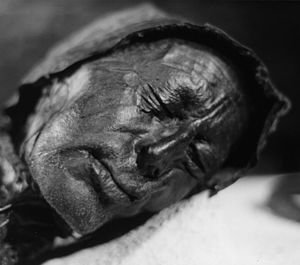
Relevant to this find is Tollund Man, a naturally occurring mummy found in a bog that was also located on the Jutland Peninsula. (Photo Below)
 http://upload.wikimedia.org/wikipedia/commons/thumb/4/44/Tollundmannen.jpg/300px-Tollundmannen.jpg
Reference
Jarcho, S (1970). Bulletin of the New York Academy of medicine. Vol. 46, issue 7, pp. 554-557
Sorenson, Irene Berg (2012). An Entire Army sacrificed in a Bog. ScienceNordic. Accessed on March 4th 2013 URL: http://sciencenordic.com/entire-army-sacrificed-bog
I quoted "bog type" as these burials were not initially placed in a bog environment, but in a small basin located near Lake Masso. The land was later covered by water and soil making this type of archaeology very expensive as water must constantly be pumped out of the regions being excavated. As of the date of publication, only a meer 80-90 square metres had been excavated out of 3,600.
Few weapons have been found with the buried, but this is not a signal of prestige or personal items necessarily. These weapons were found in limited numbers, and most of these bones were found with cut markings and blunt force trauma caused by swords and axes. It is assumed that these bodies were left to rot, but not in the position they were left. What is presumed, is that under these circumstances the battlefield in which these bodies were massacred must have been near to their final destination. Gnaw marks on bones are indicative of above ground display for some time, as predators were able to access the bones.
 |
| An archaeologists uncovers evidence of the bog bodies http://sciencenordic.com/sites/default/files/gallery%2010.jpg |
The importance of these finds are that they agree with written accounts of Teuton warfire, whom existed around the time of the birth of Jesus Christ. One of the greatest historians of the Roman Empire, Tacitus (56 AD – 120 AD) described the aftermath of the Roman’s famous defeat in the Battle of the Teutonburg Forest in 9 AD. The writings indicate that high ranking centurions were sacrificed and that piles of bodies were stacked in accordance to whether the soldiers fled or fought. This type of action could perhaps be seen with more archaeological work in the field in the area if the bodies were treated the same, further demonstrating that this is in fact the site written about. The bodies range from around the age of 13 to 45, and thus far showing no specific specialty to age, or at least, it is not noted in the article. The numbers of the burials do coincide with the writings of Tacitus who wrote that the Teutons killed all surviving enemies, this is assured by the shear numbers involved in the burial. The physical evidence found at this site is extraordinary in its condition, which highlights the importance of this type of burial and this type of research. What i find the most profound is the continuance of DNA samples that are to be obtained from these types of burials. In this particular case, the bones were so fresh that DNA was able to be extracted and now there can be concrete evidence as to what iron Age man looks like, and can indicate diet and lifestyle from some of the first mass groups found in Northern Europe.
Relevant to this find is Tollund Man, a naturally occurring mummy found in a bog that was also located on the Jutland Peninsula. (Photo Below)
http://upload.wikimedia.org/wikipedia/commons/thumb/4/44/Tollundmannen.jpg/300px-Tollundmannen.jpgReference
Jarcho, S (1970). Bulletin of the New York Academy of medicine. Vol. 46, issue 7, pp. 554-557
Sorenson, Irene Berg (2012). An Entire Army sacrificed in a Bog. ScienceNordic. Accessed on March 4th 2013 URL: http://sciencenordic.com/entire-army-sacrificed-bog
Wednesday, 13 March 2013
I'll Sleep When I'm Dead, or Vice Versa
In a recently revealed study by the University of Warwick and Frederico II University Medical School in Naples, Italy there has been data found that notes people who sleep less than six hours per night were up to 12% more likely to have an earlier death than those who achieve the recommended amounts- between 6-8 hours per.
The study had more than 1.3 million participants who were followed for up to 25 years, with over 100,000 deaths actually recorded; this makes the data unequivocal in regards to the breadth of the study. These findings were published in the journal Sleep.
Leader of the Sleep, Health, and Society Programme at the University of Warwick and Consultant Physician at the University Hospitals Coventry and Warwickshire NHS Trust, Francesco Cappuccio speaks "whilst short sleep may represent a cause of ill-health, long sleep is believed to represent more an indicator of ill-health," and has described the patterns in a modern context as being caused by the gradual reduction in the average amount of sleep due to the societal pressures involved in working long hours, or shift work (Cappuccio; 2010).
It is an interesting concept to locate how some cultures connect sleep and death, through either religious ideals, or medical means and how they interpret their inter-connectedness. Some written accounts demonstrate how some contemporary religious beliefs treat death and sleep such as the Christian Bible. Some examples are:
1) Sleep in the dust of the ground will awake, these to everlasting life, but the others to disgrace and everlasting contempt (Daniel; 12:2).
2) Thou hast swept them away like a flood, they fall asleep (Psalm; 90:5).
3) For David ... fell asleep, and was laid among his fathers, and underwent decay (Acts; 13:36 )
Obviously with Christian death there is a belief in conscious existence after the passing of an individual. In an archaeological context we can perhaps see this in accordance with certain burial practices. In Christian Burials we see a large number buried facing East, for it is said in the bible that this is the place where Jesus will rise (not formally) "But for you who revere my Name, the Sun of righteousness will rise with healing in its wings (Malachi; 4:2)." This indicates that there is an association with waking in regards to death.


The most frequently seen text in Western Society related to death would be R.I.P or Rest in Peace, pointing to the direct connectedness of sleep to death, most frequently referenced in Christian type burials.
Other religions interpret sleep as being more equivocal to that of modern day practice in sleep study. Sleep studies are primarily a new scientific class. As well, sleep is a special topic in the Islamic religion; readings from the Quran and Hadith both discuss the importance of sleep and its practices. Islam considers sleep as one of the signs of the greatness of Allah (God) and encourages followers to explore this important sign. The Quran describes different types of sleep, and these correspond with sleep stages identified by modern science (BaHammam; 2011). Some primary concerns of the Islam religion revolve around accounting for one's daily deeds. The Imams have highly encouraged us to reflect on our deeds before going to sleep and particularly remember the sins we may have committed during the day. It is especially important to ask Allah for forgiveness of our sins, because we never know if we will even awaken from our sleep the next morning. Keeping that thought in mind, and with the help of Allah and a little bit of will power, we can hopefully refrain from committing those undesirable deeds in the future (Masood; 2010). Time of sleeping is also important in the Islamic religion(s). It is undesirable to sleep between "true" day and sunrise, between Maghrib and Isha, and after Asr prayer; as well, it is noted that sleeping during the morning hours can lessen the livelihood of the day. Strong recommendations are made to have a short nap before the Dhuhr prayers during summer. Followers of Islam are told they should remain awake during the night only in three cases: for Salatul Layl (the Night Prayer), for the recitation of the Holy Quran and for studying, and for a newly-married bride who arrives in her husband's house (Masood; 2010)
The patterns of sleep referenced in Islamic practice are closely matched to those in modern science, and the literal interpretation of books in the Quran can be examined as ancient practices of health studies in the field. We may be able to make some inferences about religion that stress the importance of sleep, some patterns that may translate archaeologically. Patterns we see in Christian burials may match Islamic burials as the bodies of deceased Muslims must face towards Mecca, thus depending on the place on earth, the graves may face the same direction. Some religions see sleep as being of utmost importance and perhaps we can see how this is displayed or conceived in certain religions through the archaeological record. Cross-cultural patterns of burials may eventually be interpreted as patterns in importance of sleep in either death, or in life and wellness.


BaHammam, Ahmed. Sleep From an Islamic Perspective. 2011 Oct-Dec; 6(4): 187–192.
Ann Thorac Med. 2011 Oct-Dec; 6(4): 187–192. doi: 10.4103/1817-1737.84771
PMCID: PMC3183634
Cappuccio FP, Elia L, Strazzullo P & Miller MA. Sleep duration and all-cause mortality: a systematic review and meta-analysis of prospective studies. Sleep, 2010; 33 (5)
Masood, Farah. How do we sleep? Islamic Insights. July 2010
http://islamicinsights.com/religion/religion/how-do-we-sleep.html
The English Standard Version Bible: Containging the Old and New Testaments with Apocrypha. Oxford: Oxford UP, 2009.
Tuesday, 5 March 2013
Strange Cemeteries?
Just a few of my favourite cemeteries that I have come across...
The Cimetiere des Chiens at Autres Animaux Domestiques opened in 1899 in Asnieres-sur-Seine, France. The title translates to English as "The Cemetery of Dogs and Other Domestic Animals." The cemetery is the eternal home for a wide range of other animals other than dogs and cats, including horse, monkeys, and even lions.
 The impressive entrance to the cemetery was designed by famous architect Eugene Petit in Art Nouveau style which only hints at the level of prestige once bestowed on the residents of this cemetery. This cemetery was researved for the pets of the famous and ultra-welathy, essentially only those who could afford to place their pets here. the mass scultpures, and monuments reflect this wealth and demonstrates that status does not just have to be represented in human burials alone.
The Wuyi Mountain Hanging Cemetery is another one of my favourite "strange" burial grounds. Located in the Fujian Province of China this mountain is the final resting place of hundreds of Chinese peoples. Coffins of this style are left straddling the sides of the mountain on ledges or planks for families to come visit. In China, they are known as Xuanguan, and is an ancient Asian funeral custom which means that these types of burials are not unique to this specific mountain or area.They are said to appear in the Chinese history, as early as in the Zhou Dynasty. The practice is said to have been created for minority groups despite the nature of the burial and the obvious amount of work that went into the burial. The traditional belief is that this type of "burial" would prevent beasts and spirits from taking the bodies.

I chose these two gravesites to raise questions about burials; how they are important for different ethnicities and beliefs around the world, and the truth behind the strangeness of these practices. We can always make inferences as to what status means in a given society usually based on "wealth" but how do we draw on what is important as there may be a complex blend of individuality and affordability much like there is today in the past. Also i just wanted to show you some different graves that I find fun to examine whether we actually can learn anything from them or not!
The Cimetiere des Chiens at Autres Animaux Domestiques opened in 1899 in Asnieres-sur-Seine, France. The title translates to English as "The Cemetery of Dogs and Other Domestic Animals." The cemetery is the eternal home for a wide range of other animals other than dogs and cats, including horse, monkeys, and even lions.

The Wuyi Mountain Hanging Cemetery is another one of my favourite "strange" burial grounds. Located in the Fujian Province of China this mountain is the final resting place of hundreds of Chinese peoples. Coffins of this style are left straddling the sides of the mountain on ledges or planks for families to come visit. In China, they are known as Xuanguan, and is an ancient Asian funeral custom which means that these types of burials are not unique to this specific mountain or area.They are said to appear in the Chinese history, as early as in the Zhou Dynasty. The practice is said to have been created for minority groups despite the nature of the burial and the obvious amount of work that went into the burial. The traditional belief is that this type of "burial" would prevent beasts and spirits from taking the bodies.

I chose these two gravesites to raise questions about burials; how they are important for different ethnicities and beliefs around the world, and the truth behind the strangeness of these practices. We can always make inferences as to what status means in a given society usually based on "wealth" but how do we draw on what is important as there may be a complex blend of individuality and affordability much like there is today in the past. Also i just wanted to show you some different graves that I find fun to examine whether we actually can learn anything from them or not!
Friday, 8 February 2013
Mum's the Word: Irish Myths in China!
In the Tarim basin of Xinjiang province China, there have been more than 100 natural mummified corpses discovered, all of which were from a time period from about 4,000 and 2,400 BP. The number of mummified bodies is alone astonishing but the strangest part is that these corpses remarkably had red or blonde hair, accompanied by blue eyes, indicating they were primarily Aryan. other Aryan features discovered on the corpses to back up the case was long noses and skulls, thin lips, and deep eyes. The excellent preservation was due to the arid climate as well as the salt content of the areas they were buried in.
Reconstruction of the mummies' faces reveals a distinct Celtic look described with the features listed above, as well and perhaps more indicatively of Celtic origins are the Celtic tartans that are associated with Northwest Celtic culture.
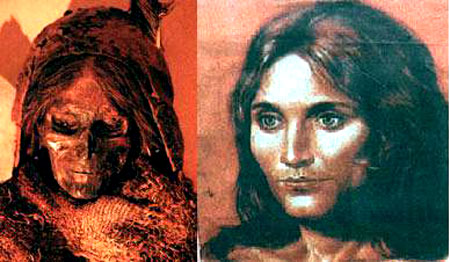
Featured below are photos of the remains of "The Lady of Tarim" and "The Beauty of Loulan." At the top you can see the red hair present from the Tocharian princess, and below is a photograph and artists rendition of the Celtic Beauty based on facial structure.

http://www.bibliotecapleyades.net/imagenes_ciencia/tuathadedanaan04_07.jpg
http://www.bibliotecapleyades.net/imagenes_ciencia/tuathadedanaan04_09.jpg
Reference
Sutherland, Mary (2013). The History of the Red Haired Race: Tautha De Danaan. Burlington News Website. http://www.burlingtonnews.net/ Accessed: 08/02/2013
A few of these mummies are on display in Beijing including "The Lady of Tarim" who has blonde hair and blue eyes and has become quite a story in China; apparently this woman was thought to be a priestess or princess over 3,000 years ago. This was indicated by fine embroidery of wool and leather garments as well as jewelry, jars and other ornaments of gold, silver and jade- items that today still hold significant value. She is in such pristine condition it is said that it is if she is just sleeping.
One such mummy of a teenaged girl with blond hair and blue yes,
found in a cave, has become quite a tourist attraction in Beijing. She has been
nicknamed "The Lady of Tarim" and she is on display to throngs of museum
visitors in the Chinese capital.
Other famous mummies found in the region were Tocharian Mummies, named after the builders of the roads in the area at around 2,000 years ago. These included the "Beauty of Loulan" and a unnamed male mummy, buried with a clay bowl engraved with a swastika, deriving from an Indo-European language and meaning something in the range of "well-being."Reconstruction of the mummies' faces reveals a distinct Celtic look described with the features listed above, as well and perhaps more indicatively of Celtic origins are the Celtic tartans that are associated with Northwest Celtic culture.
Featured below are photos of the remains of "The Lady of Tarim" and "The Beauty of Loulan." At the top you can see the red hair present from the Tocharian princess, and below is a photograph and artists rendition of the Celtic Beauty based on facial structure.
http://www.bibliotecapleyades.net/imagenes_ciencia/tuathadedanaan04_07.jpg
http://www.bibliotecapleyades.net/imagenes_ciencia/tuathadedanaan04_09.jpg
Reference
Sutherland, Mary (2013). The History of the Red Haired Race: Tautha De Danaan. Burlington News Website. http://www.burlingtonnews.net/ Accessed: 08/02/2013
Thursday, 7 February 2013
Cemetery and Burial Analysis
I recently found out how tedious and time consuming that cemetery data analysis can be; this was highlited by the many difficulties and trials that accompanied our class assignment on data analysis. First I relaized that it is not something that can easily be taught in one day, and many problems can arise when pilfering through someone else' data if it was not properly documented or easily accessible if search for via the Access Program.
Collection of data, is a difficult process on its own, as in regards to cemtery analysis, most graves whether they be marked or not, seem to have some degree of degradation and thus begins the tortuous nature of cemetery data. Creating data bases, is something I am less familiar with, but I assume that it is equally as long of a process, if not more. If you have properly organized notes from your graves, then the process may not be as difficult, but I can see how poor data taking techniuqes can now prolong the database portion as you now would have to organize the data into sections or groups to be accessible in a meaningful manner.
Databases make it easy for analysis, when done properly, if one thinks clearly about what they're looking for in the database, the ability for it to locate absense and presence in a number, such as a quantity of a trait in a graveyard like unmarked gravestones is an absolute convenience. Programs such as Access add to the convenience by allocating pre-designated search Que's to help locate and place specialized data. It was easy to see how useful technology can be, but the inherent problem is now understanding how to use this technology.
I would liked to have gone into the stats portion if there were more time, as I have indicated, I do not have a complete scope quite yet on creating databases let alone analyzing the statistics. The only cure for the learning process is time, and any time spent in this area is of "grave" importance if one is to pursue a job in the field of archaeology.
Collection of data, is a difficult process on its own, as in regards to cemtery analysis, most graves whether they be marked or not, seem to have some degree of degradation and thus begins the tortuous nature of cemetery data. Creating data bases, is something I am less familiar with, but I assume that it is equally as long of a process, if not more. If you have properly organized notes from your graves, then the process may not be as difficult, but I can see how poor data taking techniuqes can now prolong the database portion as you now would have to organize the data into sections or groups to be accessible in a meaningful manner.
Databases make it easy for analysis, when done properly, if one thinks clearly about what they're looking for in the database, the ability for it to locate absense and presence in a number, such as a quantity of a trait in a graveyard like unmarked gravestones is an absolute convenience. Programs such as Access add to the convenience by allocating pre-designated search Que's to help locate and place specialized data. It was easy to see how useful technology can be, but the inherent problem is now understanding how to use this technology.
I would liked to have gone into the stats portion if there were more time, as I have indicated, I do not have a complete scope quite yet on creating databases let alone analyzing the statistics. The only cure for the learning process is time, and any time spent in this area is of "grave" importance if one is to pursue a job in the field of archaeology.
Subscribe to:
Posts (Atom)