Friday, 8 February 2013

Mum's the Word: Irish Myths in China!

     In the Tarim basin of Xinjiang province China, there have been more than 100 natural mummified corpses discovered, all of which were from a time period from about 4,000 and 2,400 BP. The number of mummified bodies is alone astonishing but the strangest part is that these corpses remarkably had red or blonde hair, accompanied by blue eyes, indicating they were primarily Aryan. other Aryan features discovered on the corpses to back up the case was long noses and skulls, thin lips, and deep eyes. The excellent preservation was due to the arid climate as well as the salt content of the areas they were buried in.   
   
     A few of these mummies are on display in Beijing including "The Lady of Tarim" who has blonde hair and blue eyes and has become quite a story in China; apparently this woman was thought to be a priestess or princess over 3,000 years ago. This was indicated by fine embroidery of wool and leather garments as well as jewelry, jars and other ornaments of gold, silver and jade- items that today still hold significant value. She is in such pristine condition it is said that it is if she is just sleeping.

One such mummy of a teenaged girl with blond hair and blue yes, found in a cave, has become quite a tourist attraction in Beijing. She has been nicknamed "The Lady of Tarim" and she is on display to throngs of museum visitors in the Chinese capital.
 
     Other famous mummies found in the region were Tocharian Mummies, named after the builders of the roads in the area at around 2,000 years ago. These included the "Beauty of Loulan" and a unnamed male mummy, buried with a clay bowl engraved with a swastika, deriving from an Indo-European language and meaning something in the range of "well-being."

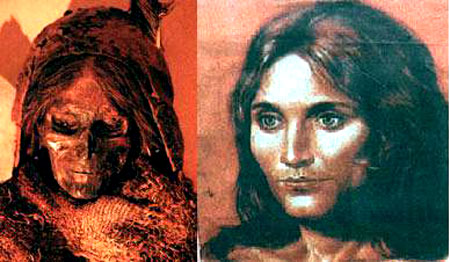
     Reconstruction of the mummies' faces reveals a distinct Celtic look described with the features listed above, as well and perhaps more indicatively of Celtic origins are the Celtic tartans that are associated with Northwest Celtic culture.

Featured below are photos of the remains of "The Lady of Tarim" and "The Beauty of Loulan." At the top you can see the red hair present from the Tocharian princess, and below is a photograph and artists rendition of the Celtic Beauty based on facial structure.


http://www.bibliotecapleyades.net/imagenes_ciencia/tuathadedanaan04_07.jpg

http://www.bibliotecapleyades.net/imagenes_ciencia/tuathadedanaan04_09.jpg


Reference

Sutherland, Mary (2013). The History of the Red Haired Race: Tautha De Danaan. Burlington News Website. http://www.burlingtonnews.net/ Accessed: 08/02/2013


Thursday, 7 February 2013

Cemetery and Burial Analysis

     I recently found out how tedious and time consuming that cemetery data analysis can be; this was highlited by the many difficulties and trials that accompanied our class assignment on data analysis. First I relaized that it is not something that can easily be taught in one day, and many problems can arise when pilfering through someone else' data if it was not properly documented or easily accessible if search for via the Access Program.

      Collection of data, is a difficult process on its own, as in regards to cemtery analysis, most graves whether they be marked or not, seem to have some degree of degradation and thus begins the tortuous nature of cemetery data. Creating data bases, is something I am less familiar with, but I assume that it is equally as long of a process, if not more. If you have properly organized notes from your graves, then the process may not be as difficult, but I can see how poor data taking techniuqes can now prolong the database portion as you now would have to organize the data into sections or groups to be accessible in a meaningful manner.

     Databases make it easy for analysis, when done properly, if one thinks clearly about what they're looking for in the database, the ability for it to locate absense and presence in a number, such as a quantity of a trait in a graveyard like unmarked gravestones is an absolute convenience. Programs such as Access add to the convenience by allocating pre-designated search Que's to help locate and place specialized data. It was easy to see how useful technology can be, but the inherent problem is now understanding how to use this technology.

     I would liked to have gone into the stats portion if there were more time, as I have indicated, I do not have a complete scope quite yet on creating databases let alone analyzing the statistics. The only cure for the learning process is time, and any time spent in this area is of "grave" importance if one is to pursue a job in the field of archaeology.