I quoted "bog type" as these burials were not initially placed in a bog environment, but in a small basin located near Lake Masso. The land was later covered by water and soil making this type of archaeology very expensive as water must constantly be pumped out of the regions being excavated. As of the date of publication, only a meer 80-90 square metres had been excavated out of 3,600.
Few weapons have been found with the buried, but this is not a signal of prestige or personal items necessarily. These weapons were found in limited numbers, and most of these bones were found with cut markings and blunt force trauma caused by swords and axes. It is assumed that these bodies were left to rot, but not in the position they were left. What is presumed, is that under these circumstances the battlefield in which these bodies were massacred must have been near to their final destination. Gnaw marks on bones are indicative of above ground display for some time, as predators were able to access the bones.
 |
| An archaeologists uncovers evidence of the bog bodies http://sciencenordic.com/sites/default/files/gallery%2010.jpg |
The importance of these finds are that they agree with written accounts of Teuton warfire, whom existed around the time of the birth of Jesus Christ. One of the greatest historians of the Roman Empire, Tacitus (56 AD – 120 AD) described the aftermath of the Roman’s famous defeat in the Battle of the Teutonburg Forest in 9 AD. The writings indicate that high ranking centurions were sacrificed and that piles of bodies were stacked in accordance to whether the soldiers fled or fought. This type of action could perhaps be seen with more archaeological work in the field in the area if the bodies were treated the same, further demonstrating that this is in fact the site written about. The bodies range from around the age of 13 to 45, and thus far showing no specific specialty to age, or at least, it is not noted in the article. The numbers of the burials do coincide with the writings of Tacitus who wrote that the Teutons killed all surviving enemies, this is assured by the shear numbers involved in the burial. The physical evidence found at this site is extraordinary in its condition, which highlights the importance of this type of burial and this type of research. What i find the most profound is the continuance of DNA samples that are to be obtained from these types of burials. In this particular case, the bones were so fresh that DNA was able to be extracted and now there can be concrete evidence as to what iron Age man looks like, and can indicate diet and lifestyle from some of the first mass groups found in Northern Europe.
Relevant to this find is Tollund Man, a naturally occurring mummy found in a bog that was also located on the Jutland Peninsula. (Photo Below)
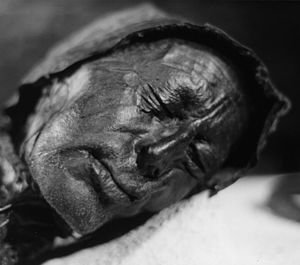 http://upload.wikimedia.org/wikipedia/commons/thumb/4/44/Tollundmannen.jpg/300px-Tollundmannen.jpg
Reference
Jarcho, S (1970). Bulletin of the New York Academy of medicine. Vol. 46, issue 7, pp. 554-557
Sorenson, Irene Berg (2012). An Entire Army sacrificed in a Bog. ScienceNordic. Accessed on March 4th 2013 URL: http://sciencenordic.com/entire-army-sacrificed-bog

No comments:
Post a Comment