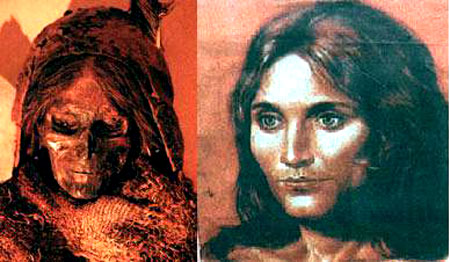
A few of these mummies are on display in Beijing including "The Lady of Tarim" who has blonde hair and blue eyes and has become quite a story in China; apparently this woman was thought to be a priestess or princess over 3,000 years ago. This was indicated by fine embroidery of wool and leather garments as well as jewelry, jars and other ornaments of gold, silver and jade- items that today still hold significant value. She is in such pristine condition it is said that it is if she is just sleeping.
One such mummy of a teenaged girl with blond hair and blue yes,
found in a cave, has become quite a tourist attraction in Beijing. She has been
nicknamed "The Lady of Tarim" and she is on display to throngs of museum
visitors in the Chinese capital.
Other famous mummies found in the region were Tocharian Mummies, named after the builders of the roads in the area at around 2,000 years ago. These included the "Beauty of Loulan" and a unnamed male mummy, buried with a clay bowl engraved with a swastika, deriving from an Indo-European language and meaning something in the range of "well-being."Reconstruction of the mummies' faces reveals a distinct Celtic look described with the features listed above, as well and perhaps more indicatively of Celtic origins are the Celtic tartans that are associated with Northwest Celtic culture.
Featured below are photos of the remains of "The Lady of Tarim" and "The Beauty of Loulan." At the top you can see the red hair present from the Tocharian princess, and below is a photograph and artists rendition of the Celtic Beauty based on facial structure.

http://www.bibliotecapleyades.net/imagenes_ciencia/tuathadedanaan04_07.jpg
http://www.bibliotecapleyades.net/imagenes_ciencia/tuathadedanaan04_09.jpg
Reference
Sutherland, Mary (2013). The History of the Red Haired Race: Tautha De Danaan. Burlington News Website. http://www.burlingtonnews.net/ Accessed: 08/02/2013

No comments:
Post a Comment